
Planetary systems across the Milky Way. Credit: M. Kornmesser, ESO
(full-size image available here)
Two decades of exoplanetary
astronomy have shown that system evolution tends to produce two kinds of
planets: high-mass objects like Jupiter and Saturn, whose bulk composition is
dominated by hydrogen, and low-mass objects like Uranus and Earth, which consist
mostly of heavy elements. Observations suggest that individual systems might
feature one species to the exclusion of the other: gas giants only, as in
Upsilon Andromedae and HIP 14180, or low-mass planets only, as in HD 40307 and
HD 69830.
It looks like dwarfs are common,
while giants are less so, and the two species are often in conflict.
Yet about 20% of all exoplanetary
systems with at least two planets contain examples of both species. Within this
group (which has seen considerable growth in the past few years, thanks to the
Kepler Mission) just under half contain exactly two planets. In every one of
these, the low-mass planet has the inner orbit, and the gas giant has the outer orbit. Among the remainder
– i.e., mixed-mass systems with at least three planets – just under half
contain exactly one low-mass planet, again as the innermost planet in every case.
At the current reckoning, we have
found only 10 systems with at
least two low-mass planets and at least one gas giant. That amounts to 1.5% of all exoplanetary
systems detected by transit and radial velocity searches. While the percentage
is small, it represents an integrated architectural design that happens to
characterize our own Solar System. We
Earthlings were fortunate enough to evolve in the presence of two reasonably
congenial gas giants flanked by a half-dozen low-mass planets in various
flavors and sizes.
This unique architectural type was unknown in the extrasolar universe before
2010, when a second low-mass planet was reported in orbit around GJ 876. It
remained rare enough to seem anomalous until 2012, when Kepler-25 and Kepler-30
(each containing two low-mass planets and one gas giant) were confirmed,
joining GJ 876 and HD 10180. Several more such systems have been announced in
the past 12 months, all thanks to Kepler data. The species of gas giants, which
I’ve characterized in the past as aloof and predatory, now reveals a fuzzier,
more gregarious side, while the clannish low-mass types are proving more
accommodating to massive outsiders.
This post describes four newly confirmed
Kepler systems that present a set of variations on the theme of compact,
mixed-mass design. All have at least one gas giant and one low-mass planet, and three out of four have at least two low-mass planets. The four host stars range from about 0.96 Solar masses (0.96
Msol) to 1.25 Msol. The corresponding range in spectral types is early G to
late F. Although stellar enrichment in
metals is significantly associated with the presence of gas giant planets,
only one of the four stars is metal-rich (Kepler-88 at +0.20). Among the other
three, one has Solar metallicity (Kepler-89) and the other two are sub-Solar (Kepler-87
at -0.17 and Kepler-90 at -0.12).
Notably, the gas giants in all
four of these systems occupy the orbital space known as the period valley (Wittenmyer et al. 2010). This is the region
between 0.1 and 1 AU, where known extrasolar giants are much less abundant than
they are in the hot zone inside 0.1 AU (the range of Hot Jupiters) and somewhat
less abundant than in the temperate region between 1 and 1.5 AU (where Earth
and Mars orbit in our Solar System).
In three of these systems, transit timing variations (TTV) permit
an estimate of planetary masses, and in two of them, at least one planet has
been confirmed by radial velocity (RV)
observations. The availability of data on mass through two different observational
methods makes these systems unusually valuable for the study of planetary
structure, system architecture, and system evolution.
Figure 1.
Kepler-88 system architecture (also known as KOI-142)

Kepler-88 is the scene of an
exoplanetary trifecta. Its architecture has been revealed by three different channels:
transit light curves, TTV, and RV. The resulting numbers provide evidence for
two planets: a low-mass object on a short-period orbit and a gas giant on a
slightly wider orbit, whose period is exactly double that of the inner planet.
This configuration is known as a mean motion resonance, an orbital relationship
that links a small fraction of known planet pairs (Goldreich & Schlichting
2014). The most common mean motion resonance is 2:1, which is the type observed
here.
Kepler-88b is a puffy gas
dwarf, similar in size to Uranus and Neptune (but probably less massive), while
Kepler-88c is a gas giant somewhere between Saturn and Jupiter in mass. Both
are locked in a precise spin near the brink of their host star’s gravity well.
Table 1. Kepler 88 system parameters (also known as KOI-142)

Column 2 gives the mass in Earth units (two different values are
available for Kepler-88c); Column 3 gives the radius in Earth units; Column 4
gives the semimajor axis in astronomical units (AU); Column 5 gives the orbital
eccentricity; Column 6 gives the period in days; and Column 7 gives an estimate
of the equilibrium temperature (Teq) provided by the Kepler site.
. . . . . . . . . . . . . . .
Kepler-88b orbits very close to
its host star, in a period of about 11 days. Because the star is only 60% as
luminous as our Sun, the planet’s equilibrium temperature is just 12% higher
than that of Mercury. Since the early Kepler results became available, it has
been apparent that this object (originally known as KOI-142.01) experiences
large TTVs – indeed, their amplitude is the largest ever recorded among Kepler
candidates. Given the absence of other transiting planets in this system, at
least on periods shorter than a few hundred days, it has long been evident that
one or more non-transiting companions must be responsible for these TTVs.
David Nesvorny and colleagues used
the Kepler-88 transit data to calculate the characteristics of the implied
planetary system. They found a mass about 8.7 times Earth (8.7 Mea) for
Kepler-88b, equivalent to half the mass of Neptune. They also confirmed the
presence of a second planet, Kepler-88c, with a mass about 0.63 times Jupiter
(0.63 Mjup, equivalent to 199 Mea) and an orbital period just over 22 days.
At the same time, S.C. Barros and
colleagues conducted RV observations of Kepler-88 that also confirmed the
presence of Kepler-88c, finding an orbital period identical to that returned by
Nesvorny’s group. However, their estimate of the object’s minimum mass (0.76
Mjup / 242 Mea) was notably larger than the mass calculated with TTVs.
Nevertheless, Barros’ group presented their estimate with very generous error
margins, which permit a range of masses between 200 and 343 Mea for Kepler-88c.
Thus the findings of the two studies are marginally consistent.
The tendency for mass values
determined by RVs to be systematically larger than those determined by TTVs has
been discussed in a recent study by Lauren Weiss and Geoff Marcy (Weiss &
Marcy 2014). They argue that the discrepancy is unlikely to result from a bias
in the RV data. They suggest two possibilities: 1) TTV-derived masses are low
because other, undetected planets in the same system are “damping” the TTVs, or
2) systems with the compact architecture that is most likely to produce TTVs
(e.g., Kepler-11) have “lower-density planets than non-compact systems.”
Whatever the explanation may be, it remains true that we have only TTV data to
characterize the masses of the small planets detected by Kepler. Sadly, such
data are available only for a small fraction of systems. Nor can we hope to
obtain RV data on any of these planets, since they are so distant that no
existing instrument can measure the minuscule variations that they induce in
their host stars’ motion. If the TTV data are wrong, then our current
understanding of planet structure loses much of its support.
For Kepler-88c, at least, the discrepancy between the two
mass determinations does not substantially change our picture of the system. We
see an architecture somewhat reminiscent of a few other exoplanetary systems
near and far: 55 Cancri, HD 3651, and Kepler-30. Each of them contains a planet
about the mass of Uranus on a short-period orbit, plus one or more gas giants
in the period valley.
Neither photometric nor RV data provide evidence of any other
planets around Kepler-88, but it seems unlikely that the orbital space is
simply empty outside 0.15 AU. Additional low-mass planets that (like Kepler-88c)
are non-coplanar with Kepler-88b would be invisible to both search methods.
Also open are questions about the origins of this system:
how did the known planets form and become entangled in their present
relationship? With luck, some investigators will address this problem soon.
Figure 2.
Kepler-89 system architecture (also known as KOI-94)

Kepler-89 looks like an
augmentation or upgrade of Kepler-88. Instead of two planets we have four, all
transiting and all on orbits smaller than Mercury’s. As in Kepler-88, we see a
low-mass planet with a puffy radius, Kepler-89c, completing an orbit in just
over 10 days. Immediately outside is Kepler-89d, a gas giant the same size as
Jupiter on an orbit of about 22 days. But there’s more. Immediately inside
planet c is an even smaller object, Kepler-89b, which is small enough to be
rocky and close enough to its host to sustain a lava ocean. Many similar
Hellworlds have been reported. Immediately outside planet d, the gas giant, is
another puffy dwarf, Kepler-89e: a familiar planetary type in a configuration
almost unknown outside our Solar System.
By this I mean an arrangement in
which one or more low-mass planets orbit exterior to one or more gas giants.
The Solar System exemplifies this architecture in the nested orbits of Jupiter,
Saturn, Uranus, and Neptune – two gas giants encircled by two low-mass planets.
To date, however, out of several hundred exoplanetary systems, only four offer scaled-down
analogs: Kepler-30, Kepler-87, Kepler-89, and GJ 876. Space-based transit
surveys have clearly been more effective than RV in exposing this rare design.
Table 2. Kepler-89 system parameters (also known as KOI-94)

Column 2 gives the mass in Earth units; Column 3 gives the radius
in Earth units; Column 4 gives the semimajor axis in astronomical units (AU); Column
5 gives the period in days; and Column 6 gives an estimate of the equilibrium
temperature (Teq) in Kelvin. Most of the quantities in Column 2, and all in
Column 3, have two alternative estimates. M indicates values from Masuda et al.
(2013). W indicates values from Weiss et al. (2013).
. . . . . . . . . . . . . . .
Two different studies have tried
to define the masses of these planets, as shown in Table 2. Their results are
even less consistent than the conflicting values for Kepler-88, providing
another example of the mismatch between TTV and RV results. In this case, the
two groups also worked from slightly different values for stellar mass and (apparently)
radius, but this disparity cannot explain the wide divergence of their findings.
Using TTVs and a stellar mass of
1.25 Msol, Masuda and colleagues estimated Kepler-89d at about 52 Earth masses
(52 Mea). This measurement places it right on the threshold of the gas giant
population, within a sparsely attested mass range. For Kepler-89c and 89-e,
which flank the orbit of 89-d, they found masses in the range of Uranus and
Neptune.
Using RV data and a stellar mass
of 1.28 Msol, Weiss and colleagues found that Kepler-89d was heavier than
Saturn, at about 106 Mea: this is more than double the result from the other
study. They also found larger masses for the two adjacent planets, in
particular 89-e, which in their analysis would be double the mass of Neptune.
As with Kepler-88, the discrepancy
between these studies does not change our overall picture of the system. Both
models of Kepler-89d present a planet whose bulk composition is dominated by
hydrogen, consistent with a gas giant like Saturn rather than a more metallic
planet like Neptune. The two adjacent companions also remain more or less
consistent with our understanding of gas dwarfs, even if the high-mass model of
Kepler-89e stretches the limits.
Masuda et al. did not estimate a
mass for the innermost planet, which does not participate in the TTVs. Although
Weiss et al. present a mass range centered on 10 Mea, they concede its unreliability.
We are better informed by the radius measurement: whether at 1.6 or 1.7 Rea, the
tight orbit and hot primary star of Kepler-89b point to a bare rock of about 7
to 10 Mea – a Super Hellworld.
We also have an excellent
understanding of the relative orbital alignment of the four known planets.
Because all four are observed in transit, Kepler-89 must be a very “flat”
system, with its planets sharing the same orbital plane (see Mass
Matters). In addition, a mutual eclipse of two planets has been observed,
and the Rossiter-McLaughin effect has been measured during a transit of the
largest planet (Masuda et al. 2013). All evidence agrees that Kepler-89 is a
placid, well-aligned system. A history of major dynamic instabilities seems
unlikely.
Figure 3.
Kepler-87 system architecture
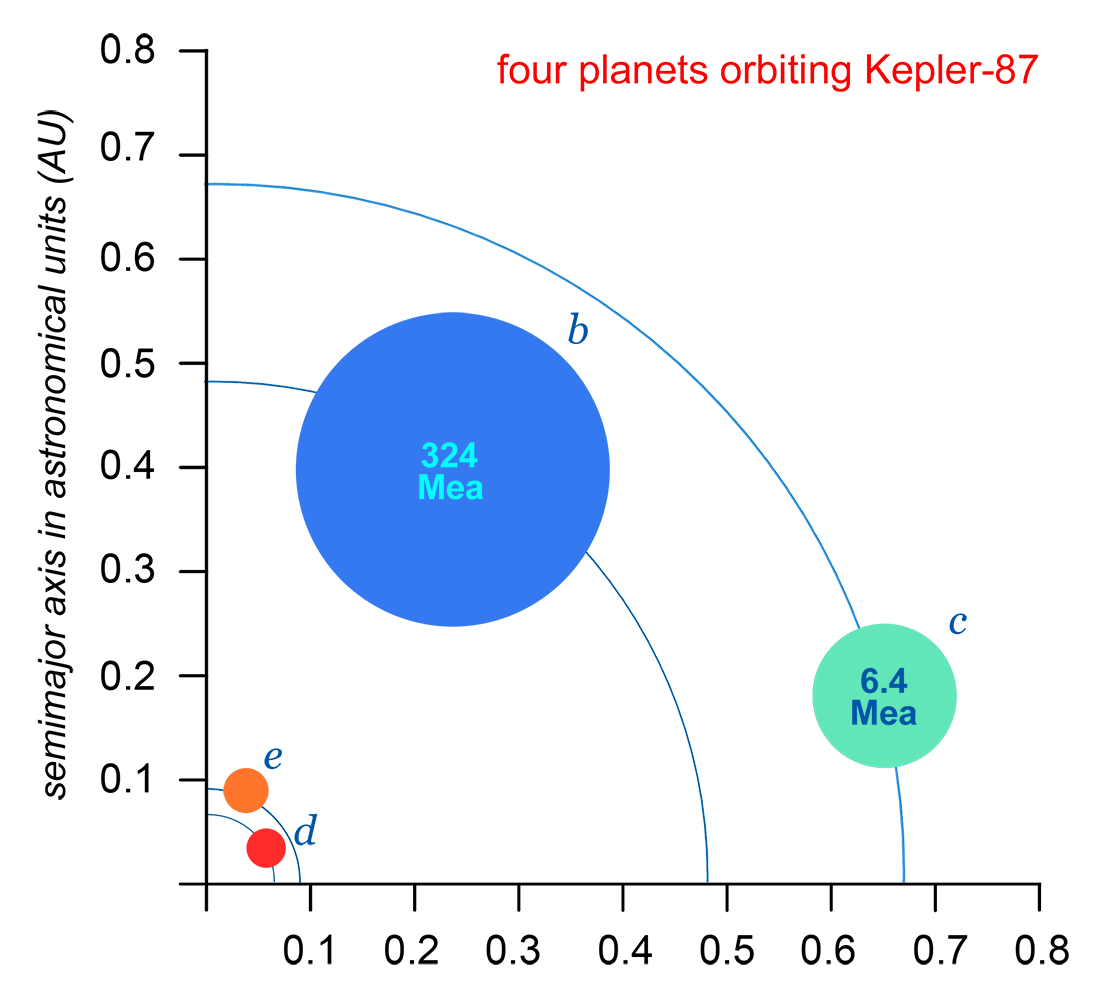
Kepler-87 is a sibling of
Kepler-89. Again we see four planets, with one low-mass planet near 0.1 AU and
another, smaller companion orbiting inside. In this system, however, neither of
the inner planets (d, e) is large enough to accommodate a substantial hydrogen
envelope. Both must be rocky Hellworlds. As in Kepler-89, the third planet is a
gas giant, though it is much farther from the star and not engaged in a mean
motion resonance. With a period of about 115 days, this planet (b) has a
semimajor axis wider than Mercury’s. The fourth planet (c) is a puffy low-mass
object with a semimajor axis within 10% of that of Venus.
Table 3. Kepler 87 system parameters
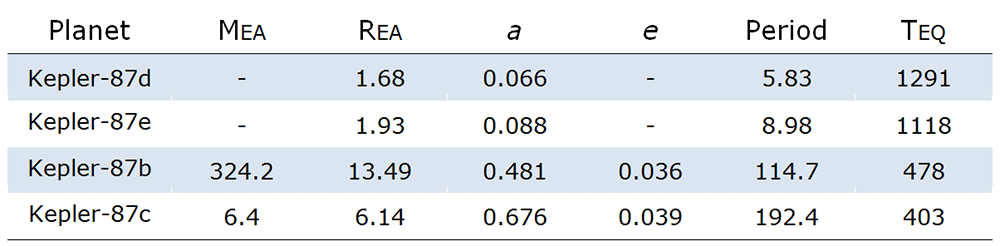
Column 2 gives the mass in Earth units; Column 3 gives the radius
in Earth units; Column 4 gives the semimajor axis in astronomical units (AU); Column
5 gives the orbital eccentricity; Column 6 gives the period in days; and Column
7 gives an estimate of the equilibrium temperature (Teq) in Kelvin provided by
the Kepler site.
. . . . . . . . . . . . . . .
Ofir and colleagues (2014) confirmed
that the two outer planets experience TTVs, which permit calculation of their
masses. They found that Kepler-87b is slightly more massive than Jupiter, as
well as slightly larger. Kepler-87c, however, appears unusually puffy for its
mass, which is only half that of Uranus. Although no RV studies have been
attempted (and thus no competing data are involved), it is impossible not to
consider these findings in light of Weiss and Marcy 2014. Perhaps the TTVs are providing
a lower mass boundary rather than a precise figure.
As Ofir’s group observes, “The relatively high multiplicity
of this system [is] notable against the general paucity of multiple systems in
the presence of giant planets like Kepler-87 b.”
Figure 4.
Kepler-90 system architecture (also known as KOI-351 / KIC 11442793)

In many ways, Kepler 90 is the
most remarkable of this quartet of variegated systems, since it offers the
jaw-dropping prospect of seven transiting planets within a period of 332 days.
Still better, Kepler 90 presents diverse radii, from an Earth-size planet (c)
to rivals of Saturn (g) and Jupiter (h). If only Pythagoras, or for that matter
Johannes Kepler himself, could have glimpsed this array!
Table 4. Kepler 90 system parameters (also known as KOI-351 / KIC 11442793)

Column 3 gives the radius in Earth units; Column 4 gives the
semimajor axis in astronomical units (AU); Column 5 gives the orbital period in
days; and Column 6 gives an estimate of the equilibrium temperature (Teq) in
Kelvin. All values were retrieved from the Kepler site in December
2013.
. . . . . . . . . . . . . . .
Yet we have no information on any
of the planets’ masses, except for hints provided by radius and estimated
equilibrium temperatures. Large TTVs have been reported for planet g, indicating strong gravitational interactions with planet h, but so far these data have not yielded any mass estimates for either planet (Cabrera et al. 2014). Nor have
any RV studies been reported. Fortunately, the latest article by
Jack Lissauer’s group offers the news that a detailed analysis of the system is
in preparation by Eric Agol and colleagues. We’ll wait in anticipatory
ignorance until it appears.
Meanwhile, we can contemplate the
picture of a strange sibling to our own Solar System, with seven planets
instead of eight, and all of them packed within a space equivalent to the
Earth’s orbit around the Sun. The two candidate gas giants may be similar in
mass to our own pair, but they are just as likely to be less massive. Cabrera and colleagues found that both planets would be dynamically stable as long as they follow circular orbits and are less than 5 Mjup. The same group also suggested that planet g is significantly less massive than planet h, perhaps close to Neptune's mass (Cabrera et al. 2014). Among the low-mass
planets, the three largest (d, e, f) are almost certainly less massive than Uranus and Neptune, and the remaining two are probably similar in mass to Earth and Venus. Again
we glimpse the presence of truly cosmic themes and variations.
Cabrera and colleagues explored the possibility that Kepler-90g has a moon, given some blips in the light curves, but they found this prospect unlikely. At least theoretically, the outermost planet, Kepler-90h, is capable of hosting a satellite
system comparable to those of Jupiter and Saturn, as it is far enough from
the host star to retain moons over the system’s lifetime. Any such moons,
however, would be unlikely to sustain Earthlike conditions, even if they were
big enough to sustain an atmosphere. The reason is that the host star is hotter,
bigger, and more massive than our Sun (5994 K, 1.166 Rsol, 1.118 Msol),
guaranteeing a thermal environment inconsistent with liquid water even under
appropriate atmospheric pressure.
. . . . . . . . . . . . . . .
The four systems discussed here
call for a new look at theories of planet formation and secular evolution. All
four systems are closely packed, and three out of four are co-planar, arguing
against a history of planet scattering. Despite the current popularity of
theories of in situ formation for
low-mass planets, the close proximity of the gas giants to their low-mass
companions in these systems is – as far as my limited understanding can tell me
– inconsistent with in situ models.
That leaves us with the now old-fashioned scenario of accretion followed by
migration. I’m eager to see a big-picture analysis of multiplanet system
architectures and their likely origins, something along the lines of the work
by Edward Thommes a few years back (2008a, 2008b).
REFERENCES
Barros SCC, Díaz RF, Santerne A,
Bruno G, Deleuil M, Almenara J-M, Bonomo AS, Bouchy F, Damiani C, Hébrard G,
Montagnier G, Moutou C. (2014) SOPHIE velocimetry of Kepler transit candidates XI.
KOI-142 c: first radial velocity confirmation of a non-transiting exoplanet
discovered by transit timing. Astronomy
& Astrophysics 561, L1. Abstract: http://adsabs.harvard.edu/abs/2014A%26A...561L...1B
[Kepler-88] Cabrera J, Csizmadia S, Lehmann H, Dvorak R, Gandolfi D, Rauer H, Erikson A, Dreyer C, Eigmüller P, Hatzes A. (2014) The Planetary System to KIC 11442793: A Compact Analogue to the Solar System. Astrophysical Journal 781, 18. Abstract: http://adsabs.harvard.edu/abs/2013arXiv1310.6248C [Kepler-90]
Goldreich P, Schlichting HE. (2014). Overstable librations can account for the paucity of mean motion resonances among exoplanet pairs. Astronomical Journal 147, 32.
Lissauer JJ, Marcy GW, Bryson ST, Rowe JF, Jontof-Hutter D, Agol A, Borucki WJ, Carter JA, Ford EB, Gilliland RL, Kolbl R, Star KM, Steffen JH, Torres G. (2014) Validation of Kepler’s multiple planet candidates. II: Refined statistical framework and descriptions of systems of special interest. Astrophysical Journal, in press. Abstract: http://adsabs.harvard.edu/abs/2014arXiv1402.6534R.
Masuda K, Hirano T, Taruya A, Nagasawa M, Suto Y. (2013) Characterization of the KOI-94 system with transit timing variation analysis: Implication for the planet-planet eclipse. Astrophysical Journal 778, 185. Abstract: http://adsabs.harvard.edu/abs/2013ApJ...778..185M [Kepler-89]
Nesvorny D, Kipping D, Terrell D, Hartman J, Bakos GA, Buchhave LA. (2013) KOI-142, the king of transit variations, is a pair of planets near the 2:1 resonance. Astrophysical Journal 777, 3. Abstract: http://adsabs.harvard.edu/abs/2013ApJ...777....3N [Kepler-88]
Ofir A, Dreizler S, Zechmeister M, Husser TO. (2014) An independent planet search in the Kepler dataset II. An extremely low-density super-Earth mass planet around Kepler-87. Astronomy & Astrophysics 561, A103. Abstract: http://adsabs.harvard.edu/abs/2013arXiv1310.2064O [Kepler-87]
Pierens A, Nelson RP. (2008) Constraints on resonant-trapping for two planets embedded in a protoplanetary disc .Astronomy & Astrophysics 482, 333-340.
Schmitt JR, Wang J, Fischer DA, Jek KJ, Moriarty JC, Boyajian TS, Megan E. Schwamb, Chris Lintott, Smith AS, Parrish M, Schawinski K, Lynn S, Simpson R, Omohundro M, Winarski T, Goodman SJ, Jebson T, Lacourse D. (2013) Planet Hunters VI: The first Kepler seven-planet candidate system and 13 other planet candidates from the Kepler archival data. Astrophysical Journal, in press. Abstract: http://adsabs.harvard.edu/abs/2013arXiv1310.5912S [Kepler-90]
Thommes EW, Bryden G, Wu Y, Rasio FA. (2008a) From mean-motion resonances to scattered planets: Producing the Solar System, eccentric exoplanets and Late Heavy Bombardments. Astrophysical Journal 675, 1538-1548. Abstract.
Thommes EW, Matsumura S, Rasio FA. (2008b) Gas disks to gas giants: Simulating the birth of planetary systems. Science 321, 814-817. Abstract; additional content.
Weiss LM, Marcy GW, Rowe JF, Howard AW, Isaacson H, Fortney JJ, Miller N, Demory BO, Fischer DA, Adams ER, Dupree AK, Howell SB, Kolbl R, Johnson JA, Horch EP, Everett ME, Fabrycky DC, Seager S. (2013) The mass of KOI-94d and a relation for planet radius, mass, and incident flux. Astrophysical Journal 768, 14. Abstract: http://adsabs.harvard.edu/abs/2013ApJ...768...14W [Kepler-89]
Weiss LM, Marcy GW. (2014) The mass-radius relation between 63 exoplanets smaller than 4 Earth radii. Astrophysical Journal Letters 783, L6. Abstract: http://arxiv.org/abs/1312.0936
Wittenmyer RA, Simon J. O’Toole, H. R. A. Jones, C. G. Tinney, R. P. Butler, B. D. Carter, and J. Bailey. (2010) The frequency of low-mass exoplanets. II. The “Period Valley.” Astrophysical Journal, 722:1854–1863.


