Figure 1. TW Hydrae,
the nearest protoplanetary disk observed at high resolution by the Atacama
Large Millimeter/submillimeter Array (ALMA). The disk
has an approximate radius of 80 AU, which is twice the semimajor axis of Pluto
in our Solar System. For other physical parameters of TW Hydrae, see Table 1 below.
-----------------------------
This is the second installment in a series about current
theories of the formation of planetary systems. Part One
provides background on planetology and system architecture. This installment begins
with an overview of protoplanetary disks,
which are the site of all planet formation, and then proceeds to outline one
popular theory: in situ accretion.
Astronomical discoveries over the last two decades have established
that planetary systems are an ordinary outcome of star formation. The formation
process begins in the depths of dark, cold, massive clouds of gas and dust, typically
located in the spiral arms of their parent galaxies. Individual clumps of gas
collapse under their own gravity to fuel the ignition of stars, which are born
as hot, bloated spheres. Baby stars arrive swaddled in remnants of their native
cocoons: vaporous leftovers known as protoplanetary nebulae (Figures 1-4). As a star spins, its surrounding
nebula flattens into a disk-like structure through which molecules of
hydrogen/helium (H/He) and dust swirl in a ratio of about 100:1 (Williams &
Cieza 2011, hereafter WC11). The ambient “dust” consists of ices of various compositions
mixed with refractory particles of metals and silicates.
The primordial disk is a kind of pancake made of clouds, except
that it puffs up around the edges and eventually evaporates instead of turning
crispy. Its basic ingredients determine the nature of the planetary residue left
behind when the cloud disperses. Among the most important characteristics of the
protoplanetary disk are its overall mass and chemical composition, especially
the proportion of heavy elements (particularly iron) to hydrogen. This
proportion is known as metallicity
and expressed as [Fe/H], on a scale where zero equals the metallicity of our
Sun. Another potential contributor to gestating planets is the ratio of water
to silicates in the composition of the ambient dust (Bitsch & Johansen
2016), although this topic has not been studied as well as metallicity and mass.
High metallicity is robustly associated with the presence
of gas giant planets – that is,
objects of at least 50 Earth masses (50 Mea) but less than 13 Jupiter masses
(13 Mjup) – whereas low-mass planets
occur around stars of all chemical compositions (Buchhave & al. 2012). Stellar
mass is also a predictor of gas giant companions. At constant metallicity,
stars more massive than the Sun are more likely to host gas giants than stars
of Solar mass or less (Johnson & al. 2010).
Extensive observations of star-forming regions have
demonstrated that the mass of a protoplanetary disk scales roughly with the
mass of its parent star. This relationship suggests a further correlation
between disk mass and planet mass (WC11, Andrews et al. 2013). Despite a
significant dispersion at any given value, a typical disk is probably 1% or
less of the mass of its parent star, possibly in the range of 0.2% to 0.6%. The
median mass for disks around Sun-like stars might be as low as 5 Mjup (WC11),
equivalent to 0.48% of the Sun’s mass (o.0048 Msol).
Figure 2. The ALMA Three

These spectacular photographs by the ALMA instrument captured three nearby protoplanetary disks – HL Tauri,
TW Hydrae, and V883 Orionis – that differ significantly in radius, mass, and
age. See Table 1 for individual
parameters.
-------------------------
The observed radial extent of protoplanetary disks shows at least as much variation as their masses. Disk radii in nearby star-forming regions range from about 15 to 200 astronomical units (AU), with outliers in the range of 400 to 600 AU (WC11). A survey of the Orion Nebula estimated that three-quarters of all disks have radii smaller than 75 AU (WC11). By comparison, the radius of Neptune’s orbit is about 30 AU, while the aphelion of Pluto (i.e., its widest separation from the Sun) is about 50 AU. Current theory places the outer boundary of the original Solar nebula at Neptune’s orbit. If that estimate is accurate, our system’s protoplanetary disk would fall near the low end of the distribution of disk radii.
Disk mass has no necessary correspondence with disk
radius, as evidenced by the largest protoplanetary disk observed in the Orion
Nebula (Bally & al. 2015). Known as 114-426, this object is observed almost
edge-on, with a radius of 475 AU. Dust is concentrated inside 175 AU. Despite
these impressive dimensions, the central star is evidently an early M or late K
dwarf with a mass in the range of 0.4-0.7 Msol. The estimated disk mass is only
3.1 Mjup (0.003 Msol). Nevertheless, recent observations indicate that 114-426
has undergone substantial evolution, even though its age is only 1-2 million
years. Much of its original solid mass has likely already congealed into
planetesimals and protoplanets.
Table 1.
Parameters of the ALMA Three (see Figure
2)

Abbreviations: AU = astronomical unit (93
million miles/150 million km); Msol = Solar mass; Myr = millions of years; Pc =
parsec (3.26 light years). Sources: Nomura et al. 2016, Andrews et al. 2016, ALMA
Partnership 2015, Cieza et al. 2016.
-----------------------------
The recent high-resolution imaging of three active
protoplanetary disks suggests that this new sample is somewhat atypical. As summarized
in Table 1, the masses of these structures exceed the proposed means. At an age
of half a million years, the disk around V883 Orionis has a radius of about 125
AU and an imposing mass of 0.3 Msol, about 20% of the mass of its F-type host
star. At an age of 1 million years, the HL Tauri disk is about 100 AU in extent
with a poorly constrained mass of 0.03-0.14 Msol. At an age approaching 10
million years, the TW Hydrae disk has a radius of 75 AU or more and a mass of 0.05
Msol. It may be that these earliest image captures are outliers within the full
sample of nearby protoplanetary disks. If so, we would have a parallel between
extrasolar disks and extrasolar planets: Although Hot Jupiters dominated the
exoplanetary census in the late 1990s, this planetary type comprises less than
1% of the de-biased sample (Wright et al. 2012).
In any event, the overall life expectancy of
protoplanetary disks appears to be better constrained than their typical masses
and radii. Disks are born at the same time as their parent stars, and few (with
the notable exception of TW Hydrae) have been observed at ages of 10 million
years or more. For disks around stars of Solar mass or less, surveys regularly
find a median age of 2 to 3 million years. A recent theoretical study arrived
at a slightly higher mean age of 3.7 million years (Kimura et al. 2016). Shorter
lifetimes are observed for hotter, more massive stars, as well as for stars
with binary companions (WC11).
All these data on the mass, extent, and lifespan of protoplanetary
disks provide inescapable limits for theories of planet formation. Most
critically, any object with an atmosphere containing more than 1%-2% of its
bulk composition in H/He must have formed in the presence of a gas disk, since
no other source of light gases would be available to forming planets. That bulk
composition describes the vast majority of exoplanets detected by any method.
In sharp contrast, Earth and Venus evidently accreted many millions of years
after the dispersal of our system’s protoplanetary nebula (Hansen 2009).
Figure 3. Protoplanetary disks in the Orion Nebula

With likely ages between 1 and 2 million
years, all these young stellar objects are still embedded in their primordial
nebulae. The five photos in the center of this selection depict systems that have
evolved to the stage of flared protoplanetary disks, as revealed by their
silhouettes. Image credit: NASA/ESA/Luca Ricci.
--------------------------
minimum
mass solar nebula
Even before the availability of instruments capable of studying
nearby stellar nurseries, astronomers based inferences about the Sun’s original
nebula on the structure of the present-day Solar System. The construct of the
“minimum mass Solar nebula” (MMSN) was developed in the 1970s to estimate the
approximate mass and density of our long-vanished native cloud. Stuart
Weidenschilling (1977) provided a detailed exposition of the assumptions
underlying this model. First, the area occupied by the orbits of the eight
major planets (excluding Pluto, despite its recognition as a planet before 2006)
and the asteroid belt was divided into nine zones. Next, the bulk mass of each
governing planet or debris field was distributed evenly throughout its zone,
augmented with enough H/He to bring the zonal composition in line with the
ratio of elements in the Sun. Mercury’s zone was assumed to extend inward as
far as 0.23 AU, while Neptune’s extended outward to 41 AU.
This model enabled a rough estimate of the mass of the
original Solar nebula. Depending on assumptions about the quantity of solid
mass in the gas giant planets, estimates of the MMSN ranged from 0.01 to 0.07
Msol (Weidenschilling 1977). The same approach also enabled an estimate of the surface density of the original nebula
(i.e., its two-dimensional distribution of mass). Mercury was excluded from the
latter calculation, which indicated a peak in surface density around the orbit
of Venus and then a steady depletion out to the orbit of Neptune. Despite the
high surface density of solids inside 1 AU, the broad radial extent of the MMSN
guaranteed that most of its volatile and refractory mass lay outside 4 AU.
Weidenschilling noted that the model was intended to represent the nebula at the time of planet formation, not in its primordial state. This clarification opened the possibility that unknown evolutionary processes had transformed the original cloud. In particular, Weidenschilling emphasized the depletion of mass in Mercury’s zone (0.23-0.56 AU) as well as in the more extensive region occupied by Mars and the asteroids (1.2-4.2 AU). These notable gaps suggested a “preferential removal” of “several Earth masses of solid matter.” (For more about the missing mass problem, see Solar System Archaeology, Jupiter Descending, and Jupiter Re-Ascending.)
Four decades later, the MMSN is still regularly invoked and critiqued in theoretical studies, and investigators are still debating the mass and surface density of Solar and extrasolar nebulae. Williams & Cieza favor the low end of Weidenschilling’s mass estimate (0.01 Msol), which is equivalent to approximately 10 Mjup. They estimate that only 15% of disks around stars like our Sun harbor this much mass within radii of 50 AU, and they infer that disks harboring substantially more mass must be rare (WC11). Yet many theorists have invoked disks as much as an order of magnitude more massive than 0.01 Msol to explain specific system architectures.
As for surface density, the consensus view is that it peaks in the innermost region of the disk and trails into vacuum at the outer limits, but the shape of the slope remains controversial. Many studies have adopted a smooth power-law decline, with disagreements from author to author on the relative steepness of the slope. Meanwhile, a growing number of studies argue against a smooth slope, favoring bumps and valleys instead. This view appears to be supported by recent imaging of HL Tauri, TW Hydrae, and V883 Orionis (Figures 1 & 2).
The rings and gaps in these images, as well as the peaks and valleys in surface density predicted by theory, imply that protoplanetary disks are radially structured. Among the potential sources of this structure, two candidates are especially popular. The first is growing planets, which might carve out rings in the disk by clearing dust and potentially gas along their orbits. The second is discontinuities in heat, pressure, and density located at specific radii in the disk. These two explanations are not mutually exclusive, and indeed might be interdependent. Radial structure is the focus of Part Three in this series, which will look at such constructs as planet traps, snow lines, sublimation radii, planet deserts, sweet spots, and dead zones.
Figure 4. Artist’s view of a young protoplanetary disk

Image credit: Reported as NASA
----------------
cloud dynamics
I’ve always preferred “nebula” over “disk” to designate the environment where baby planets are born. “Nebula” makes me think of swirling gases, whereas “disk” suggests a rigid, brittle object like a CD or an LP. Although I concede that the gaps and rings revealed by ALMA actually do resemble the tracks on a vinyl LP, I still think “disk” is a dubious metaphor for the objects pictured in Figures 1-4. These clouds are fluid and highly dynamic. Their constituent gas molecules travel inward in a continuous flow to feed the central star, carrying dust along with them. At the same time, the far reaches of the nebula spread outward, such that the cloud is attenuating simultaneously at its inner and outer boundaries. It's like a candle burning at both ends.
I’ve always preferred “nebula” over “disk” to designate the environment where baby planets are born. “Nebula” makes me think of swirling gases, whereas “disk” suggests a rigid, brittle object like a CD or an LP. Although I concede that the gaps and rings revealed by ALMA actually do resemble the tracks on a vinyl LP, I still think “disk” is a dubious metaphor for the objects pictured in Figures 1-4. These clouds are fluid and highly dynamic. Their constituent gas molecules travel inward in a continuous flow to feed the central star, carrying dust along with them. At the same time, the far reaches of the nebula spread outward, such that the cloud is attenuating simultaneously at its inner and outer boundaries. It's like a candle burning at both ends.
The steady outward diffusion of gas and dust into the interstellar medium means that protoplanetary disks lack a sharp outer edge – another way in which they differ from vinyl or plastic disks. The photograph of TW Hydrae (Figure 1) illustrates this diffuse border zone. By contrast, disks have a distinct inner cavity created by the interaction between the central star’s magnetic field and the disk’s constituent gases. While accreting H/He can jump this gap to accrete through the star’s north and south magnetic poles, the cavity creates a distinct inner wall in the nebula, inside which gas dynamics cease.
When we remember that more than half of protoplanetary disks vanish within 4 million years, we get a sense of the rapid pace of their evolution. “Feverish” seems a more appropriate descriptor than “glacial.” To put the timescale in perspective, here are some big numbers: Our Solar System orbits the core of the Milky Way Galaxy in a period of about 250 million years, known as the galactic year. By that measure, our Sun is about 18 galactic years old. The Cryogenian Glaciation on our planet, often described as Snowball Earth, lasted 85 million years (from 720 to 635 million years ago). Although it was merely a single brief winter in the galactic year, this icy interval was still much longer than the span of 7 million years needed for Pan prior, the last common ancestor of apes and humans, to evolve into Homo sapiens, our own species. The accretion of mighty Jupiter, which could swallow Earth and a convoy of planets like it, probably took only half as long as that. Planet formation is a fleeting process in which small changes have big consequences, and time is of the essence.
Figure 5. Distribution of mass in selected systems with at least 3 planets

in situ formation
Until a few decades ago, astronomers believed that the Sun’s eight planets formed more or less where they are now observed. Then came the first discoveries of extrasolar gas giants (so-called “Hot Jupiters”) orbiting their host stars in periods of a few days or weeks. These momentous findings coincided with a rapid expansion of our understanding of protoplanetary disks, especially those in the Orion Nebula. Theorists responded to the new extrasolar data with a steadily growing body of research on the multifarious ways in which forming planets can change their orbits. In the most popular scenarios, they do so by navigating the flux of evolving nebulae. In recent years this work has resulted in a novel explanation for the apparent anomalies in our Solar System’ architecture. Known as the Grand Tack, the new model indicates that all four of the outer planets have undergone orbital migration and scattering, sometimes inward and sometimes outward, so that none of these planets are exactly where they started.
But just as cosmologists were beginning to think that the evolution of the Solar System was more like that of a typical exoplanetary system, with various regimes of migration and numerous opportunities for planet scattering and collisions, a radical new model emerged for the genesis of low-mass planets like those on the left side of Figure 5: coalescence in place, better known as in situ formation. Apart from a few earlier, more limited inquiries (Raymond et al. 2008, Montgomery & Laughlin 2009), this theory emerged in 2012-2013 as a fully-fledged paradigm.
Until a few decades ago, astronomers believed that the Sun’s eight planets formed more or less where they are now observed. Then came the first discoveries of extrasolar gas giants (so-called “Hot Jupiters”) orbiting their host stars in periods of a few days or weeks. These momentous findings coincided with a rapid expansion of our understanding of protoplanetary disks, especially those in the Orion Nebula. Theorists responded to the new extrasolar data with a steadily growing body of research on the multifarious ways in which forming planets can change their orbits. In the most popular scenarios, they do so by navigating the flux of evolving nebulae. In recent years this work has resulted in a novel explanation for the apparent anomalies in our Solar System’ architecture. Known as the Grand Tack, the new model indicates that all four of the outer planets have undergone orbital migration and scattering, sometimes inward and sometimes outward, so that none of these planets are exactly where they started.
But just as cosmologists were beginning to think that the evolution of the Solar System was more like that of a typical exoplanetary system, with various regimes of migration and numerous opportunities for planet scattering and collisions, a radical new model emerged for the genesis of low-mass planets like those on the left side of Figure 5: coalescence in place, better known as in situ formation. Apart from a few earlier, more limited inquiries (Raymond et al. 2008, Montgomery & Laughlin 2009), this theory emerged in 2012-2013 as a fully-fledged paradigm.
In this model, planets of several Earth masses readily form in place on short-period orbits, tracing the distribution of solids in the protoplanetary disk. Eugene Chiang & Greg Laughlin (2013) presented a “strict” version (their word) of this hypothesis. Arguing that “disk-driven migration seems too poorly understood to connect meaningfully with observations,” they deprecated models that require migration as both “premature” and “naïve.” In their place they proposed a minimum mass extrasolar nebula (MMEN). This construct was obtained by plotting the masses and orbits of the small Kepler planets then known and constructing a disk in which the concentration of solids matched the location of the planets. Results highlighted the pile-up of planetary mass inside 0.25 AU, which is correlated with the rapidly declining likelihood of detecting transiting planets on periods longer than 10 days.
Contrary to standard models of the MMSN, which feature a gap with a radius of about 0.5 AU at the center of the protoplanetary disk, Chiang & Laughlin preferred an inner disk edge around 0.05 AU. They associate this boundary with the dust sublimation radius around a mature Sun-like star – the radius within which silicate particles transition to gas, removing the possibility of accretion. The surface density of their MMEN peaks at this location and declines smoothly with increasing distance.
Given this structure, the MMEN could support a much larger concentration of solids at small semimajor axes than previous models. After boosting its overall mass by a factor of 5 to 10, Chiang & Laughlin proposed that the MMEN could even support an in situ origin for the planets of Kepler-11 and other high-multiplicity systems.
Meanwhile, Brad Hansen & Norm Murray (2012) had already presented a “less strict” variation on this approach (according to Chiang & Laughlin). They proposed that 30-100 Mea of solids could migrate from the outer regions of the protoplanetary disk to clump within 1 AU, where planetesimals would congregate and rapidly condense into an ensemble of Super Earths (which I would call gas dwarfs). Perhaps to distinguish their approach from one that relies exclusively on solids of local origin, they used the term “in situ assembly” to describe it. (The questions raised by this migration + assembly scenario differ from the ones posed by the MMEN, as we’ll see below.)
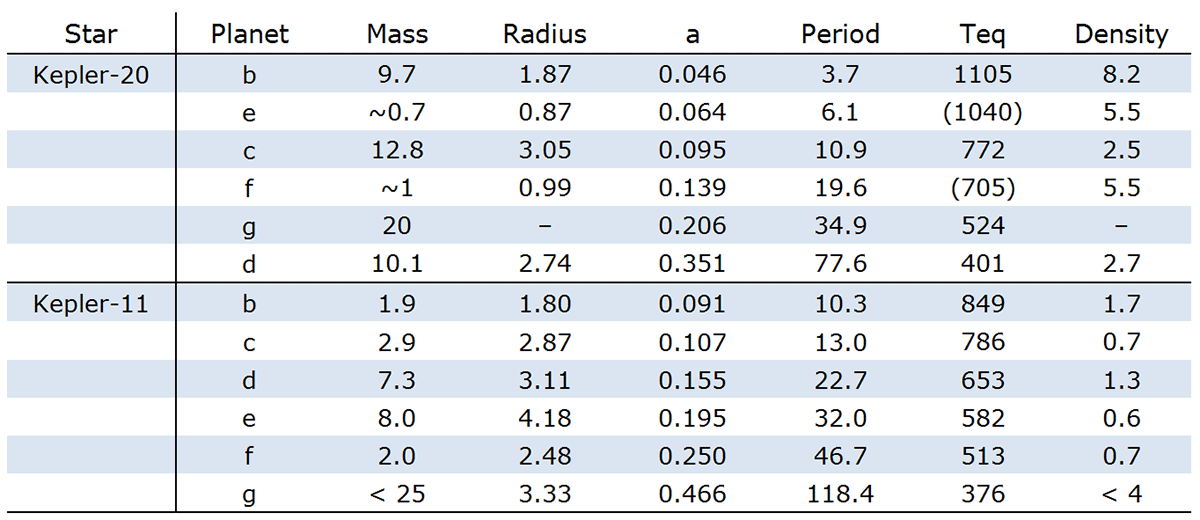
Critiques of in situ theory came pretty quickly. The principal objection was that the MMEN is inconsistent with observations of actual protoplanetary disks. The high mass required for in situ formation inside 1 AU can be obtained only with extreme fine-tuning: Either the overall disk mass must be many times larger than the MMSN, or the surface density profile of the disk must be far steeper than that of the MMSN (Raymond et al. 2014). Sean Raymond & colleagues offered the example of a disk with a radius of 50 AU and an overall mass of 0.05 Msol – that is, 5 to 25 times the typical disk mass estimated by CW11 and Andrews et al. 2013. With a slope in surface density similar to the MMSN, such a disk would harbor only 0.4 to 3 Mea inside 1 AU, hardly enough to build a system like Kepler-11 or Kepler-20 (see Figure 5). Only a substantially steeper decline in surface density would supply as much as 40 Mea in the inner region of the disk.
Now, we know that some stars harbor protoplanetary disks on the order of 0.1 to 0.3 Msol, and it’s possible that some fraction of them also support central concentrations of mass consistent with the quantities needed for in situ assembly of hot gas dwarfs. But the whole point of in situ models was to capture “a major if not the dominant mode of planet formation in the Galaxy” (Chiang & Laughlin 2013), not to showcase a rare and unlikely pathway to a widespread system architecture.
Another major objection was that the MMEN implies a universal disk structure that is incompatible with the diversity of known multiplanet systems (Raymond & Cossou 2014). Sean Raymond & Christophe Cossou attempted to construct their own version of the MMEN, following the approach of Chiang & Laughlin. They took a sample of exoplanetary systems with at least three low-mass planets inside 1 AU, smoothly distributed all masses in each system in a series of concentric rings (as Weidenschilling did to construct the MMSN), and attempted to build a single disk model that could reproduce their sample. It was an impossible task. Not only would it require an unrealistically large disk mass (two to three times larger than the value proposed by Chiang & Laughlin for their MMEN) – no single profile could accommodate the diverse sample of available systems. In some of them, the mass profile had to increase with radial distance, which is implausible. In others, the slope was so steep that it produced unphysical distributions. The authors were able to demonstrate that “a universal disc profile is statistically excluded at high confidence.”
As they concluded: “The known systems of hot super-Earths must therefore not represent the structure of their parent gas discs and cannot have predominantly formed in situ. We instead interpret the diversity of disc slopes as the imprint of a process that re-arranged the solids relative to the gas in the inner parts of protoplanetary discs.” (Raymond & Cossou 2014).
In other words, the observed architectures of planetary systems do not reflect their primordial distribution of solid mass. Yet the “strict” in situ model favored by Chiang & Laughlin ruled out migration, the likeliest mechanism for concentrating solid mass at small semimajor axes.
Other critiques focused specifically on this anti-migrationist assumption. André Izidoro & colleagues (2014) argued, “Assuming that no migration occurs essentially ignores 30 years of disk-planet studies that show the inevitability of orbital migration.” Similarly, Kevin Schlaufman (2014) found that, without migration, the observed Kepler system architectures would be impossible.
Yet another flaw in the model was identified by one of its proponents, Eugene Chiang, in collaboration with first author Eve Lee and co-author Chris Ormel. As Lee & colleagues (2014) noted, the same conditions that favor the assembly of gas dwarfs in the range of 5-10 Mea at small semimajor axes are equally favorable to the formation of gas giants at the same locations. Since the latter outcome is not observed – gas giants are much less common than low-mass planets inside 1 AU – in situ theory needs adjustment. They proposed that the formation of planets capable of accreting hydrogen atmospheres must be delayed until shortly before the dissipation of the nebular gas. Otherwise, planets of a few Earth masses would rapidly balloon into warm and hot gas giants. Although this looks like a case of fine-tuning, the authors did not suggest a mechanism to account for the delay. Thus we might have another example of a scenario that would apply only to a small fraction of extant planetary systems, rather than representing a characteristic and widely encountered mode of planet formation.
immobility versus drift
All these critiques have resulted in revisions in more recent in situ models, with some studies discarding the MMEN altogether and invoking in its place either a) drift of solids or even b) migration of fully-formed planets from cooler regions of the protoplanetary disk into short-period orbits (e.g., Lee & Chiang 2016). In fact, one of the earliest self-described in situ scenarios (Hansen & Murray 2012) conceded that locally available solids inside 1 AU would probably be insufficient to form systems like Kepler 11 or Kepler 20. Therefore, in a series of articles published 2012-2015, lead author Brad Hansen proposed either migration or radial drift to explain the accumulation of 20-100 Mea of solids in the inner regions of protoplanetary disks.
But does such an approach still qualify as an in situ model? In an extended footnote to their recent study of the formation of Jupiter, Sean Raymond & colleagues say no:
“This model should not be confused with the strict ‘in-situ accretion’ model, which conjectures that hot super-Earths form locally from locally-condensed solids (proposed and subsequently rejected by Raymond et al. 2008, then re-proposed by Chiang & Laughlin (2013)). In-situ accretion requires extremely massive disks very close to their stars (Chiang & Laughlin 2013). There are many arguments against the strict in-situ accretion model (see Raymond et al. 2008, 2014; Schlichting 2014; Schlaufman 2014; Raymond & Cossou 2014; Inamdar & Schlichting 2015; Ogihara et al. 2015). We propose that models that invoke the inward drift of solids followed by accretion at close-in orbital radii should be referred to as a separate category of ‘drift’ models rather than being lumped together with in situ accretion.” (Raymond et al. 2016)
------------------
Indeed, Hansen himself has noted various criticisms of in situ approaches, even expressing a degree of support for models that depend heavily on migration:
“. . . the speed and even direction of migration depend on the imperfect cancellation between the torques exerted by the disk interior and exterior to the planet. One possibility, suggested by several authors (e.g., Masset et al. 2006), is that the torque may reverse sign at particular locations in the disk, leading to “planet traps”—preferred locations where planets assemble. It is possible that our power-law surface density profile may simply represent an averaged version of a disk with several such preferred locations, and that some disks may have more localized distributions which could contribute to the overabundance of low-multiplicity systems. Indeed, this might help to place our solar system in the Kepler context, as our own terrestrial planet system is potentially the outcome of a disk with a single localized planet trap.” (Hansen & Murray 2013)
------------------
all accretion is local
From my back alley perspective it looks like the exoplanet community’s recent flirtation with in situ hypotheses has cooled off. The diverse problems with this approach have now been widely discussed. Meanwhile, no study to date has presented a planetary system whose architecture can be explained only by strict in situ assembly. Instead, any system architecture that might appear consistent with in situ formation (e.g., Proxima Centauri or Kepler-11) can be explained even more plausibly by a scenario involving migration (Coleman et al. 2016, D’Angelo & Bodenheimer 2016).
From my back alley perspective it looks like the exoplanet community’s recent flirtation with in situ hypotheses has cooled off. The diverse problems with this approach have now been widely discussed. Meanwhile, no study to date has presented a planetary system whose architecture can be explained only by strict in situ assembly. Instead, any system architecture that might appear consistent with in situ formation (e.g., Proxima Centauri or Kepler-11) can be explained even more plausibly by a scenario involving migration (Coleman et al. 2016, D’Angelo & Bodenheimer 2016).
I don’t mean to suggest that in situ models have been a waste of time. Their elaboration in the literature has inspired many researchers to look more closely at the ways in which solids and gas can be incorporated by planets forming in the inner regions of a protoplanetary disk. The result has been in a net gain in our understanding of accretion. Just as important, in situ theorists have successfully retired models in which solids are necessarily depleted from protoplanetary nebulae inside 0.5 AU. This move represents a further advance in the Copernican paradigm, which displaces our Solar System from its position as the reference case for evolutionary models. We now understand that a system of four or five planets, with masses ranging from 0.5 Mea to about 2 Mea, might form in situ on orbits ranging from 10 to 500 days – without invoking some special mechanism to boost the local mass in solids. Instead, it’s clear that the depletion of mass in the ancient Solar System is the oddity that needs explanation.
Whether solids are present ab initio in the feeding zone of a protoplanet, or whether they migrate there in the form of pebbles or planetesimals from elsewhere in the disk, all accretion is local. The universe has evolved manifold pathways to move mass from one region of a dusty nebula to another. These paths will be explored in the final installment of the series, which reviews current variations on the theme of disk-driven migration.
REFERENCES
ALMA Partnership, et al. (2015) First results from high
angular resolution ALMA observations toward the HL Tau region. Astrophysical Journal Letters 808, L3.
Andrews SM, Rosenfeld KA, Kraus AL, Wilner DJ. (2013)
The mass dependence between protoplanetary disks and their stellar hosts. Astrophysical Journal 771, 129.
Andrews SM. (2015) Observations of solids in
protoplanetary disks. Publications of the
Astronomical Society of Pacific 127, 961-993.
Andrews SM, Wilner DJ, Zhu Z, Birnstiel T, Carpenter
JM, Perez LM, Bai XN, Oberg K, Hughes AM, Isella A, Ricci L. (2016) Ringed
substructure and a gap at 1 AU in the nearest protoplanetary disk. Astrophysical Journal Letters 820, L40.
Bally J, Mann RK, Eisner J, Andrews SM, Di Francesco
J, Hughes M, Johnstone D, Matthews B, Ricci L, Williams JP. (2015) ALMA
observations of the largest proto-planetary disk in the Orion Nebula, 114–426: a
CO silhouette. Astrophysical Journal
808, 69.
Bitsch B, Johansen A. (2016) Influence of the water content
in protoplanetary discs on planet migration and formation. Astronomy & Astrophysics 590, A101.
Buchhave L, Latham DW, Johansen A, Bizzarro M, Torres
G, Rowe JF, Batalha NM, Borucki WJ, et al. (2012) An abundance of small
exoplanets around stars with a wide range of metallicities. Nature 486, 375-377.
Chiang E, Laughlin G. (2013) The
minimum-mass extrasolar nebula: in situ
formation of close-in Super-Earths. Monthly
Notices of the Royal Astronomical Society 431, 3444-3455. Abstract: 2013MNRAS.431.3444C
Cieza L, Casassus S, Tobin
J, Bos SP, Williams JP, Perez Z, et al. (2016) Imaging the water snow-line
during a protostellar outburst. Nature
535, 258-261.
Coleman GAL, Nelson RP,
Paardekooper SJ, Dreizler S, Giesers B, Anglada-Escude G. (2016) Exploring
plausible formation scenarios for the planet candidate orbiting Proxima
Centauri. In press. Abstract: 2016arXiv160806908C
D’Angelo G,
Bodenheimer P. (2016) In situ and ex situ formation models of Kepler 11
planets. Astrophysical Journal 828,
33. Abstract: 2016ApJ...828...33D
Hansen B. (2009) Formation of
the terrestrial planets from a narrow annulus. Astrophysical Journal 703,
1131-1140. Abstract: 2009ApJ...703.1131H
Hansen B, Murray N. (2012) Migration
then assembly: Formation of Neptune-mass planets inside 1 AU. Astrophysical Journal 751, 158.
Abstract: 2012ApJ...751..158H
Hansen B, Murray N. (2013) Testing in situ assembly with the Kepler planet
candidate sample. Astrophysical Journal
775, 53. Abstract: 2013ApJ...775...53H
Hansen BMS. (2014) The
circulation of dust in protoplanetary discs and the initial conditions of
planet formation. Monthly Notices of the
Royal Astronomical Society 440, 3545-3556. Abstract: 2014MNRAS.440.3545H
Hansen BMS. (2015) In situ models for planet assembly
around cool stars. International Journal
of Astrobiology 14, 267-278.
Inamdar NK, Schlichting HE. (2015) The formation
of Super-Earths and Mini-Neptunes with giant impacts. Monthly Notices of the Royal Astronomical Society 448, 1751-1760.
Izidoro A, Morbidelli A, Raymond SN. (2014)
Terrestrial planet formation in the presence of migrating Super-Earths. Astrophysical Journal 794, 11.
Johnson JA, Aller KM, Howard
AW, Crepp JR. (2010) Giant planet occurrence in the stellar mass-metallicity
plane. Publications of the Astronomical
Society of the Pacific 122, 905-915.
Kimura S, Kunitomo M,
Takahashi S. (2016) From birth to death of protoplanetary disks: Modeling their
formation, evolution, and dispersal. Monthly Notices of the Royal Astronomical Society 461, 2257-2265.
Lee EJ, Chiang E, Ormel CW.
(2014 ) Make Super-Earths, not Jupiters: Accreting nebular gas onto solid cores
at 0.1 AU and beyond. Astrophysical
Journal 797, 95. Abstract: 2014ApJ...797...95L
Lee EJ, Chiang E. (2016) Breeding
Super-Earths and birthing Super-Puffs in transitional disks. Astrophysical Journal 817, 90. Abstract: 2016ApJ...817...90L
Lissauer JJ. (1993) Planet
Formation. Annual Review of Astronomy
& Astrophysics 1993, 31: 129-174.
Masset FS,
Morbidelli A, Crida A, Ferreira J. (2006) Disk surface density transitions as
protoplanet traps. Astrophysical Journal 642,
478–487.
Montgomery R, Laughlin G. (2009) Formation and detection of Earth
mass planets around low mass stars. Icarus
202, 1-11.
Nomura H, Tsugakoshi T,
Kawabe R, Ishimoto D, Okuzumi S, Muto T, et al. (2016) ALMA observations of a
gap and a ring in the protoplanetary disk around TW Hya. Astrophysical Journal Letters 819, L7.
Pollack JB, Hubickyj O, Bodenheimer
P, Lissauer JJ, Podolak M, Greenzweig Y. (1996) Formation of the giant planets
by concurrent accretion of solids and gas. Icarus
124, 62-85.
Raymond SN,
Barnes R, Mandell AM. (2008) Observable consequences of planet formation models
in systems with close-in terrestrial planets. Monthly Notices of the Royal Astronomical Society 384, 663–674.
Raymond SN, Kokubo E,
Morbidelli A, Morishima R, Walsh KJ. (2014) Terrestrial planet formation at
home and abroad. In Protostars and
Planets VI, eds. Beuther H, Klessen RS, Dullemond CP, Henning T. Tucson:
University of Arizona Press, pp 595-618.
Raymond SN, Cossou C. (2014) No
universal minimum-mass extrasolar nebula: evidence against in situ accretion
of systems of hot super-Earths. Monthly Notices of
the Royal Astronomical Society 440, L11-L15.
Raymond SN, Izidoro A, Bitsch B, Jacobson SA. (2016)
Did Jupiter’s core form in the innermost parts of the Sun’s protoplanetary
disk? Monthly Notices of the Royal
Astronomical Society 458,
2962-2972.
Schlaufman KC. (2014) Tests of in situ formation scenarios for compact multiplanet systems. Astrophysical Journal 790, 91.
Schlichting HE. (2014) Formation of close in Super-Earths
& Mini-Neptunes: Required disk masses & their implications. Astrophysical Journal Letters 795, L15.
Abstract: 2014ApJ...795L..15S
Swanson-Hysell NL, Rose CV, Calmet CC,
Halverson GP, Hurtgen MT, Maloof AC. (2010) Cryogenian glaciation and the onset
of carbon-isotope decoupling. Science
328, 608-611.
Wright JT, Marcy GW, Howard AW, Johnson JA, Morton TD,
Fischer DA. (2012) The frequency of Hot Jupiters orbiting nearby Solar-type
stars. Astrophysical Journal 753,
160.
Weidenschilling JS. (1977) The distribution of mass in
the planetary system and solar nebula. Astrophysics
and Space Science 51, 153-158.
Williams JP, Cieza
LC.
(2011) Protoplanetary disks and their evolution. Annual Review of Astronomy and Astrophysics 49, 67-117. Abstract: 2011ARA&A..49...67W