Saturday, September 17, 2016

A New Planet for Kepler-20


Figure 1. All announced planets of Kepler-20 at their relative sizes, with colors corresponding to the densities provided by Buchhave et al. 2016 (see Figure 2 for the color key; redder hues indicate higher densities). Since planet g does not transit, the radius and composition shown here are informed guesses, as indicated by the striped fill. Planets e and f are about the same size as Earth, but none of the planets in this system are cool enough to support Earth-like conditions.
----------

Lars Buchhave and colleagues just reported new radial velocity data on Kepler-20, one of the best-known systems revealed by the Kepler Mission. The new results include more precise mass estimates for three of the system’s five known planets (Kepler-20b, c, d) and robust evidence for a previously unknown sixth candidate (Kepler-20g), whose orbit is apparently misaligned with the others. The new planet is notably more massive than its five companions, but despite its short orbital period (35 days), it was not observed in transit by the Kepler Telescope.

When preliminary Kepler data started circulating in 2011, we learned that a highly specific orbital architecture is more common than anyone ever dreamed: compact systems with three or more planets visible in transit (Lissauer et al. 2011b). Lissauer & colleagues reported 55 in 2011. By May 2016, the Extrasolar Planets Encyclopaedia listed 154.

Two systems have always stood out from the pack. One is Kepler-20 (Gautier et al. 2012), which harbors five transiting planets inside a semimajor axis of 0.4 astronomical units (AU). The other is Kepler-11 (Lissauer et al. 2011a), with six transiting planets inside a semimajor axis of 0.5 AU. Both systems center on mature G-type stars like our Sun, yet each one sustains a rich multiplanet architecture confined within a radius similar to the semimajor axis of Mercury (0.39 AU). The corresponding region of our Solar System, of course, is empty.

From the beginning, Kepler-11 has received the lion’s share of attention, for one simple reason. Five of its six planets exhibit transit timing variations (TTVs), such that their orbital motion periodically speeds up or slows down to avoid awkward encounters with neighboring planets. Although this behavior had previously been theorized, Kepler-11 and another early discovery, Kepler-9, were the first cases ever actually confirmed (Ford et al. 2011).

For Kepler-11, analysis of TTVs enabled estimates of the masses of the five inner planets, which presented yet another surprise (Lissauer et al. 2011a). Although their radii were originally estimated in the range of 2 to 4.5 Earth units (Rea), all five turned out to be substantially less massive than Neptune, whose radius of 3.9 Rea contains a mass of 17.2 Earth units (Mea). Like Neptune, Lissauer & colleagues concluded, the Kepler-11 planets must be enveloped in extended atmospheres of hydrogen and helium (H/He), even though their individual masses are smaller than 10 Mea. With that inference began the modern era of planetology.

The planets of Kepler-20 are packed almost as tightly as those of Kepler-11, but no TTVs are available to provide mass estimates. Fortunately, Kepler-20 is substantially closer to our Solar System than is Kepler-11. Its distance is estimated at 290 parsecs (945 light years), versus 613 parsecs (1998 light years) for Kepler-11. This proximity enabled the collection of ground-based radial velocity observations in 2009-2011 by the Keck/HIRES spectrograph, which placed rough constraints on the masses of Kepler-20b, c, and d (Gautier et al. 2012). These constraints indicated that, despite the broad similarities between Kepler-20 and Kepler-11, the planets of the former star are both denser and more massive than those of the latter.

Figure 2. Kepler-20 and Kepler-11 Compared
 

Planets are rendered at their relative sizes on the same orbital scale, with semimajor axes in astronomical units (AU). Numbers in red indicate approximate planet masses in Earth units, rounded to the nearest integer. Planet colors indicate approximate densities, with values taken from Buchhave et al. (2016) for Kepler-20 and from Lissauer et al. (2013) for Kepler-11. Buchhave et al. propose that Kepler-20e and -20f have Earth-like compositions, given their similarity in size to Venus and Earth. The radius and composition of Kepler-20g are informed guesses, as are the mass and composition of Kepler-11g.
---------------------

Observations of these two benchmark systems have continued since their discovery. A follow-up study using additional quarters of Kepler data revised the masses and radii of the Kepler-11 planets, mostly downward, resulting in even puffier planets (Lissauer et al. 2013). Another follow-up study reported radial velocity data on Kepler-11 obtained by Keck/HIRES in 2014 (Weiss et al. 2015), placing an upper limit of twice the mass values derived by Lissauer & colleagues.

Now Buchhave & colleagues (2016) have refined the masses of the known planets around Kepler-20 and validated a sixth planet by analyzing archival HIRES data and new HARPS-N data. Figure 2, above, is a graphic comparison of the two systems based on current findings; Table 1, below, provides comparative numbers.

The most striking difference between the planetary systems of Kepler-11 and Kepler-20 appears in the bulk compositions of their planets. The estimated density of Kepler-20b substantially exceeds that of Earth, the densest planet in our system. Its composition might be explained by an enhancement in iron. Likewise, despite their similarity in mass to Uranus, Kepler-20c and -20d are much denser, indicating a smaller bulk percentage of H/He and an enrichment in metal, rock, and potentially ice. Conclusive data are lacking for the other three planets of Kepler-20, but planet g is likely to be similar in composition to planets c and d, while planets e and f might resemble our system’s terrestrial planets.

All the planets of Kepler-11 are less massive than Uranus, but two of them (b, d) have densities comparable to Neptune and Uranus, respectively. The other three planets with estimated densities (c, e, f) are comparable to Saturn, the most rarefied planet in our system, despite masses in the range of 2 to 8 Mea. For context, Saturn is 95 Mea, and if our ringed planet fell into an ocean large enough, it would float. Half the Kepler-11 planets could float along with it, bobbing like rubber ducklings after a colossal rubber duck.

kepler-20: six-planet architecture

The new study by Buchhave & colleagues (hereafter B16) begins by reexamining the properties of the host star. For Kepler-20, they report a higher mass (0.948 Solar masses or Msol), a slightly higher metallicity (+0.07 ±0.08), and an earlier spectral type (G2) than did earlier sources. These new parameters imply an even closer resemblance among Kepler-20, Kepler-11, and our own Sun than previously indicated. Kepler-20 and Kepler-11 are now assigned virtually identical masses and metallicities, while both appear older and slightly less massive than our Sun.

The most significant contribution from B16 is their discovery of the new planet, Kepler-20g. Notably, Hansen & Murray (2013) previously found that a stable orbit might be available between planets f and d, and the HARPS-N radial velocity data have confirmed their hypothesis. In addition, B16 report a more precise mass for Kepler-20d, which remains the outermost of the known planets. Its new mass value (10 Mea) is just half the upper limit reported in the discovery paper (Gautier et al. 2012), although the precision of that estimate is still inferior to those for planets b and c.

Other major results from B16 support the basic picture unveiled by the discovery paper, including null results for TTVs. As before, we see a distinctive mass distribution in which smaller, more lightweight planets alternate with larger, more massive planets inside 0.25 AU. The two smallest planets (e, f) are remarkably similar in radius – and probably in mass and composition – to the terrestrial planets of our Solar System. Their diminutive profiles are inconsistent with H/He envelopes, whereas such envelopes are essential to explain the radii of the two largest planets (c, d). We are also safe in assuming an H/He atmosphere for the most massive planet (g).

The innermost planet (b), however, appears to be rocky, without any contribution from water or H/He. Kepler-20b is therefore the most massive rocky planet discovered to date. All other objects with similar radii and well-constrained masses – with the possible exception of 55 Cancri e – require substantial volatile content to explain their profiles.

Unfortunately, B16 did not present stability limits for any additional planets that might orbit outside 0.4 AU, in the cooler region where the system’s habitable zone is located. As a result, the potential of Kepler-20 to support habitable planets remains unexplored.

Table 1. Kepler-20 and Kepler-11 System Parameters
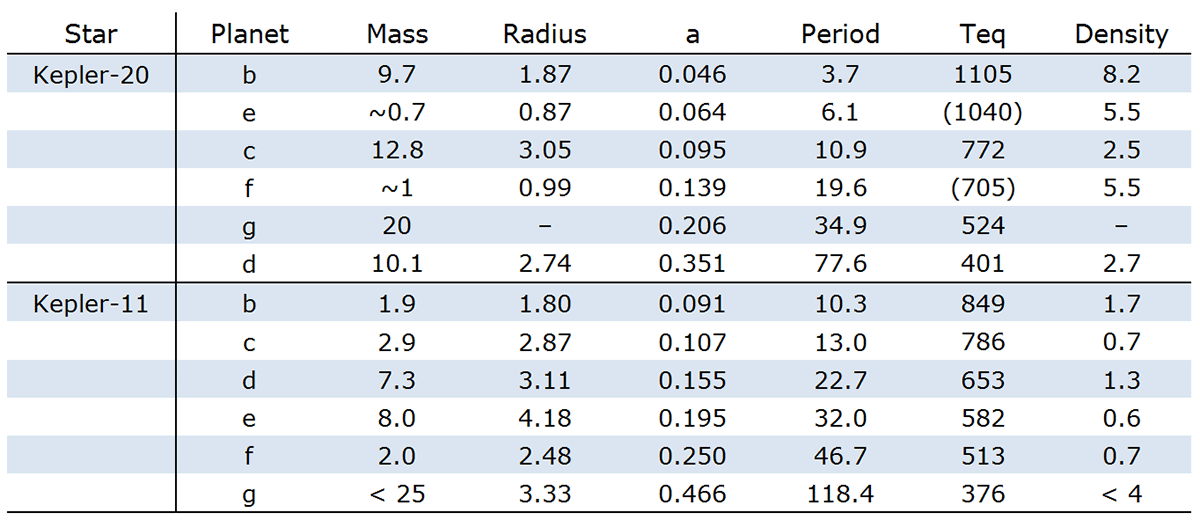
Masses and radii are expressed in Earth units. Mass is rounded to a single decimal place, with uncertainties omitted. Radius is rounded to two decimal places. a = semimajor axis, expressed in astronomical units (AU), where 1 AU = separation between Earth and Sun. Period = days. Teq = equilibrium temperature, expressed in Kelvin (K); for context, the Teq of Earth is 255 K. Density = grams/cc. Data on Kepler-20 are from Buchhave et al. 2016, except for Teq values in parentheses, which are older estimates from the Kepler Table based on a lower stellar effective temperature. Data on Kepler-11 are from Lissauer et al. 2013.
----------

kepler-11 and kepler-20: formation scenarios

Although they do not discuss any specific formation models for the planets of Kepler-20, B16 opine that all six planets assembled shortly before the dissipation of the primordial circumstellar nebula. This timing enabled all six to accrete small amounts of H/He from the nebula without initiating a runaway process that would turn them into gas giants. After the nebula dispersed, stellar flux likely ablated the H/He envelopes from planets b, e, and f – the former because of its star-hugging orbit, the latter two because of their small masses. The cooler and heavier planets (c, d, g) were able to retain their lightweight atmospheres, consistent with current models of atmospheric evolution (Lopez & Fortney 2014, Erkaev et al. 2016).

The release of B16 was almost simultaneous with the publication of a new study of possible evolutionary scenarios for Kepler-11 (D’Angelo & Bodenheimer 2016). Given the similarities between the two host stars, a scenario that can explain one system architecture should also tell us something about the other.

In their new study, Gennaro D’Angelo and Peter Bodenheimer (hereafter DB16) test the two most popular formation processes for close-in planets: 1) in situ accretion of solids locally available in the inner nebula, and 2) accretion of solids over a broad radial distance by a planetary core migrating from the outer nebula to the vicinity of the central star. For brevity they call the latter process “ex situ formation.” For each scenario they seek initial conditions that permit the formation of the known planets within currently observed parameters, and in both cases they achieve some degree of success. Accordingly, they conclude that “it is not possible to distinguish between the two modes of formation from [the planets’] final properties.”

However, a review of their models suggests that ex situ is more plausible than in situ, given two major flaws in the in situ scenario. First, DB16 find that a protoplanetary nebula massing 0.18 Msol inside 70 AU would be required to achieve the concentration of solid mass needed for in situ formation of the Kepler-11 planets inside 0.5 AU. This total is equivalent to the mass of a mid to late M dwarf star. Yet observations of protoplanetary nebulae in nearby star-forming regions indicate that most have masses in the range of 0.002 to 0.01 Msol (Williams & Cieza 2011, Andrews et al. 2013). Such findings argue that the in situ nebula invoked by DB16 is unrealistic.

In the second place, even assuming the existence of a protoplanetary nebula more massive than Proxima Centauri, the in situ model still could not produce a good analog of Kepler-11b. Since the inner nebula is completely dry in this model, the six planets originally form as rock/metal cores surrounded by H/He atmospheres. No water or other volatile materials are available to enhance their composition. Given the low core mass and tight semimajor axis of Kepler-11b, DB16 find that the planet’s primordial atmosphere would be stripped by stellar flux within 40 million years after the evaporation of the ambient nebula. To achieve the puffy radius observed today, some 8 billion years later, the planet would have to outgas very large quantities of H/He from its interior over a period lasting a few hundred million years – first to replace its original envelope, and later to replenish the outgassed atmosphere, which would remain vulnerable to stripping during the time it takes for a G star to settle into maturity (Erkaev et al. 2016). DB16 acknowledge the difficulties involved in this outcome.

Their ex situ or migratory model avoids both pitfalls. They begin with a protoplanetary nebula of 0.03 Msol inside a radius of 60 AU. Although this value is larger than a typical nebular mass, it still falls within an order of magnitude of observations, and is therefore substantially more realistic than the in situ nebula. Within this structure DB16 insert newly formed planetary cores of approximately Martian mass (0.1 Mea) at orbital radii ranging from 2.1 AU to 5.35 AU, in the region of the nebula where ices are abundant. All cores begin accreting mass and migrating inward. The timing of their insertion in the nebula is just as important as their radial placement, since cores that achieve smaller final masses need to begin accreting later than those that achieve larger masses in order to avoid orbit crossings during migration.

Because they originate in a well-hydrated region, all six forming planets accrete abundant water along with their H/He envelopes, and all are subject to loss of atmosphere once they reach their final destinations and the nebula dissipates. With this model, DB16 succeed in reproducing the masses and radii of all six planets of Kepler-11. In particular, they find that Kepler-11b retains a steam atmosphere after the loss of its lightweight H/He envelope, and that this heavier atmosphere can survive until the present age of the system, consistent with the planet’s current radius.

DB16 underscore the difference in planetary compositions produced by their two contrasting approaches to system evolution. Although they do not apply the term, the water-rich bodies resulting from their ex situ model are consistent with the Ocean Planets predicted by Leger et al. (2004).

The approach taken by DB16 is paralleled in some of the studies that accompanied the recent announcement of Proxima Centauri b (Barnes et al. 2016, Coleman et al. 2016), as discussed in my previous post. Like DB16, Coleman & colleagues explored several scenarios for planet formation, including in situ accretion in an implausibly massive protoplanetary disk, as well as long-distance migration in a more realistic disk. As with DB16, the migration scenario provided a better fit with observations than did in situ formation. Notably, Coleman’s group explicitly invoked Ocean Planets to describe the objects produced by migration.

I look forward to a study that applies similar models to the dual evolutionary histories of Kepler-20 and Kepler-11. I suspect that in situ scenarios will continue to face difficult challenges.

the high-multiplicity sample

With the confirmation of Kepler-20g, Kepler-20 moves from one exclusive club – systems with at least five known planets – to the even smaller elite – systems with at least six planets. The current exoplanetary census offers only four examples of this rare architecture: HD 10180, Kepler-11, Kepler-90, and now Kepler-20. Their orbital arrangements provide invaluable data that will continue to inform our understanding of planet formation and the distribution of specific planetary types (including temperate rocky planets) in our region of the Galaxy.


REFERENCES
Andrews SM, Rosenfeld KA, Kraus AL, Wilner DJ. (2013) The mass dependence between protoplanetary disks and their stellar hosts. Astrophysical Journal 771, 129.
Barnes R, Deitrick R, Luger R, Driscoll PE, Quinn TR, Fleming DP, Guyer B, McDonald DV, Meadows VS, Arney G, Crisp D, Domagal-Goldman SD, Lincowski A, Lustig-Yaeger J, Schwieterman E. (2016) The habitability of Proxima Centauri b I: Evolutionary scenarios. In press. Abstract: 2016arXiv160806919B
Buchhave LA, Dressing CD, Dumusque X, Rice K, Vanderburg A, Mortier A, Lopez-Morales M, Lopez E, et al. (2016) A 1.9 Earth radius rocky planet and the discovery of a non-transiting planet in the Kepler-20 system. In press. 2016arXiv160806836B
Coleman GAL, Nelson RP, Paardekooper SJ, Dreizler S, Giesers B, Anglada-Escude G. (2016) Exploring plausible formation scenarios for the planet candidate orbiting Proxima Centauri. Monthly Notices of the Royal Astronomical Society, in press. Abstract: 2016arXiv160806908C
D’Angelo G, Bodenheimer P. (2016) In situ and ex situ formation models of Kepler 11 planets. Astrophysical Journal 828, 33. Abstract: 2016ApJ...828...33D
Erkaev NV, Lammer H, Odert P, Kislyakova KG, Johnstone CP, Gudel M, Khodachenko ML. (2016) Thermal mass loss of protoplanetary cores with hydrogen-dominated atmospheres: The influences of ionization and orbital distance. Monthly Notices of the Royal Astronomical Society 460, 1300-1309.
Ford EB, Rowe JF, Fabrycky DC, Carter JA, Holman MJ, Lissauer JJ, et al. (2011) Transit timing observations from Kepler. I. Statistical analysis of the first four months. Astrophysical Journal Supplement Series 197, 2.
Fressin F, Torres G, Rowe JF, Charbonneau D, Rogers LA, Ballard S, Batalha NM, Borucki WJ, Bryson ST, Buchhave LA, et al. (2012) Two Earth-sized planets orbiting Kepler-20. Nature 482, 195-198. Abstract: 2012Natur.482..195F
Gautier TN, Charbonneau D, Rowe JF, Marcy GW, Isaacson H, Torres G, Fressin F, Rogers LA, Desert J-M, Buchhave LA, et al. (2012) Kepler-20: A Sun-like star with three sub-Neptune exoplanets and two Earth-size candidates. Astrophysical Journal 749, 15. Abstract: 2012ApJ...749...15G
Hansen B, Murray N. (2013) Testing in situ assembly with the Kepler planet candidate sample. Astrophysical Journal 775, 53. Abstract: 2013ApJ...775...53H
Leger A, Selsis F, Sotin C,  Guillot T, Despois D, Mawet D, Ollivier M, Labeque A, Valette C, Brachet F, Chazelas B, Lammer H. (2004b) A new family of planets? “Ocean Planets.” Icarus 169, 499-504.
Lissauer JJ, Fabrycky DC, Ford EB, Borucki WJ, Fressin F, Marcy GW, et al. (2011a) A closely packed system of low-mass, low-density planets transiting Kepler-11. Nature 470, 53-58. Abstract: 2011Natur.470...53L
Lissauer JJ, Ragozzine D, Fabrycky DC, Steffen JH, Ford EB, Jenkins JM, et al. (2011b) Architecture and dynamics of Kepler’s candidate multiple transiting planet systems. Astrophysical Journal Supplement Series 197, 8.
Lissauer JJ, Jontof-Hutter D, Rowe JF, Fabrycky DC, Lopez ED, Agol E, et al. (2013) All six planets known to orbit Kepler-11 have low densities. Astrophysical Journal 770, 131. Abstract: 2013ApJ...770..131L
Lopez E, Fortney J. (2014) Understanding the mass-radius relation for sub-Neptunes: Radius as a proxy for composition. Astrophysical Journal 792, 1.
Weiss LM, Marcy GW, Isaacson H, Deck KM, Lissauer JJ, Jontof-Hutter D. (2015) Constraining the masses of the Kepler-11 planets with radial velocities. Abstract presented at Physics of Exoplanets: From Earth-sized to Mini-Neptunes, February 23-27, 2015.
Williams JP, Cieza LC. (2011) Protoplanetary disks and their evolution. Annual Review of Astronomy and Astrophysics 49, 67-117. Abstract: 2011ARA&A..49...67W


Wednesday, August 31, 2016

The Perils of Proxima


Figure 1. Guillem Anglada-Escude and colleagues have announced a planet candidate with a minimum mass of 1.27 Earth units on a temperate orbit around Proxima Centauri, a tiny red dwarf that happens to be the nearest star to our Sun. This artist’s view shows the planet alongside its red host star, with the binary system of Alpha Centauri visible in the distance. Image credit: Ricardo Ramirez. 
----------

By now you’ve probably heard the news. Last week, a team led by Guillem Anglada-Escude reported radial velocity data from the HARPS spectrograph supporting the presence of a terrestrial planet orbiting Proxima Centauri, our Sun’s nearest neighbor. Proxima is an especially tiny red star of spectral type M5.5. Its mass is only 12% Solar and its luminosity is less than 1% Solar. Proxima b, as the new object is known, is also quite small for an exoplanet: its minimum mass is estimated at only 1.27 Earth units (1.27 Mea). That finding has inspired journalistic catchphrases such as “second Earth” and “Earth twin” (McKiernan 2016).

Just as newsworthy is the planet’s likely temperature. Even though Proxima b has an orbital period of only 11.2 days and a semimajor axis of only 0.049 astronomical units (AU), its host star is so dim that the planet receives just 65% of the irradiance that bathes Earth. This results in a blackbody equilibrium temperature (Teq) of 235 Kelvin (K) – which is actually cooler than Earth’s Teq of 255 K, and a bit warmer than that of Mars, at 210 K. Proxima b is located squarely in its system’s habitable zone.

Anglada-Escude and colleagues were unable to determine the eccentricity of the new planet’s orbit, offering only an upper limit of 0.35. This is a notable gap in our understanding of the overall system architecture. Nevertheless, the discovery team collected data suggesting a possible second planet orbiting Proxima Centauri with an orbital period longer than 100 days. This result meets expectations, given abundant evidence that small planets like Earth and Proxima b often have companions of similar mass.

Another limitation in our knowledge stems from the fact that Proxima b was detected by radial velocity measurements instead of transit observations. Radial velocity data can provide only a minimum mass, not a true mass, and in the absence of a transit, we have no idea of the radius of Proxima b. Thus, we cannot calculate the planet’s bulk composition, a fundamental determinant of surface conditions.

Nevertheless, despite the sparseness of the available data, and despite the excessive hype that often surrounds announcements of small planets, this is truly big news. Unlike the case of the phantom planet formerly claimed for Alpha Centauri B (Proxima’s next-door neighbor), all commentators seem satisfied with the reality of Proxima b. And if its host star were a G dwarf like our Sun or a K dwarf like HD 219134, I wouldn’t hesitate to identify Proxima b as an extrasolar Holy Grail: a potentially habitable Earth-like planet.

But Proxima Centauri is an M dwarf, and a very puny one at that. It lies near the bottom of the mass range for this spectral type, right above the cut-off for brown dwarfs (which aren’t stars). Given the findings of Luger & Barnes (2015) and Owen & Mohanty (2016) on the evolutionary and energetic characteristics of M dwarfs, my instinct is to discount the possibility that Proxima b could support oceans or complex life.

Then again, I’m not a professional astronomer whose research depends on funding from government agencies and whose career benefits from media attention. Governments and media evidently determined long ago that taxpayers/consumers have no interest in exoplanets unless they resemble Earth, Pandora, or Tatooine. Accordingly, the publication of Proxima’s detection last week in Nature was accompanied by a posse of preprints on its potential formation history and present habitability. All tried very hard to find scenarios that would yield a habitable Earth-like planet, despite the unfavorable conditions predicted for the Proxima Centauri system and others like it.

dim stars are risky bets for life

Before looking at a selection of those preprints, let’s briefly review the unfavorables, which are straightforward and stubborn:
 
First, an evolving M dwarf spends hundreds of millions of years with temperatures far higher and stellar activity more energetic than it will experience when it finally enters maturity on the main sequence (the phase in stellar evolution when hydrogen fusion occurs). This developmental history means that any planet orbiting in a red star’s mature habitable zone will likely experience runaway greenhouse conditions for hundreds of millions of years. Loss of atmosphere and water is probable, forestalling the emergence of life (Luger & Barnes 2015).

Second, during much of their long lifetimes, M dwarfs are subject to frequent flaring events and coronal mass ejections (CMEs), and they emit high levels of extreme ultraviolet radiation. This behavior subsides very slowly with age. Flares and CMEs are likely to erode the atmospheres and volatile contents of any planets orbiting in the inner systems of M dwarfs, where their habitable zones are found. Thus, even if an Earth-size planet survived an intense greenhouse in its infancy, it would still be vulnerable to evacuation of volatiles in its maturity (Luger & Barnes 2015). Again, a sterile desert is more likely than a garden.

Most of the brand-new studies on Proxima b acknowledge these two challenges.
 
Figure 2. Desert Sunset

Landscapes on red dwarf planets are more likely to resemble this photograph of sunset over the Sahara than the watery locales pictures by many optimistic space artists. Source: Wikimedia, with a red filter over the Sun.

proxima centauri sub specie aeternitatis

A team of scientists led by James Davenport, none of them associated with the Proxima discovery team, reported recent observations by the MOST satellite that underscore the harsh conditions sketched above. They found that Proxima Centauri emits flares at a tempo of at least 63 per Earth day, with superflares occurring about 8 times per Earth year (approximately once every 4 orbits of Proxima b). As they remark:

“If these flares regularly impacted Proxima b, the atmosphere would never fully recover. While this is not known to be a ‘show-stopper’ for habitability, it clearly necessitates a more detailed investigation of atmospheric response […] and photoevaporation […] for Proxima b” (Davenport et al. 2016).

Another group led by Gavin Coleman, consisting of a subset of the discovery team, conducted a set of numerical simulations to investigate four potential formation scenarios for the new planet. Each was intended to produce an analog of Proxima b within a specified range of planet masses and orbital periods. One problem with their approach, from my perspective, is that all their simulations assume an implausibly large mass for the host star’s protoplanetary disk, amounting to 4.5% of the stellar mass. By contrast, a large and growing body of observations indicates that a typical protoplanetary disk contains about 1% or less of the mass of its parent star (Williams & Cieza 2011, Andrews et al. 2013).

The first scenario explored by Coleman & colleagues was in situ accretion from a swarm of embryos and planetesimals after the dissipation of the gaseous component of the protoplanetary disk. This is similar to the process invoked to produce the four inner planets of the Solar System. Numerical simulations tended to produce compact multiplanet systems with one or more Earth-mass planets like Proxima or Venus, often with a few lower-mass planets alongside them, smaller than Venus but bigger than Mars. Across simulations, their compositions ranged from water-rich to dry, and their orbits were somewhat eccentric.

The second scenario followed the migration of several embryos with initial masses ranging from 0.05 to 0.2 Earth masses (Mea) – roughly similar to the mass of Mars – within icy and dusty regions of a gaseous protoplanetary disk extending outward to 9 AU – equivalent to the orbit of Saturn in our system. This scenario started earlier in system history than the first one, so the simulations modeled interactions between the growing embryos and the gas disk. Both inward and outward migration were enabled, and forming planets could accrete hydrogen from the disk. This scenario tended to yield one or two Earth-mass planets accompanied by a few smaller planets, as in the first scenario. However, all these planets were rich in volatiles, prompting the designation of “Ocean Planets” (Coleman et al. 2016). Their orbital eccentricities were generally smaller than those in the first scenario.

The third scenario was similar to the second, except that it featured a single migrating embryo that formed at a distance of several AU. The object was accompanied on its inward journey by a swarm of planetesimals. Each simulation in this set produced just one volatile-rich planet, whose mass varied from one to several Earth masses. Many simulation runs failed to produce planets with orbits as tight as Proxima b.

The fourth scenario also featured a single embryo growing in a gas disk, except that it was accompanied by pebbles instead of planetesimals. This scenario had the most difficulty forming an analog of Proxima b, even though the embryo tended to migrate over long distances. The authors observed that the formation of “a true Proxima analog” in this scenario would require a substantially larger disk mass than they assumed (even though they were already using an unrealistically massive disk).

Coleman & colleagues conclude by suggesting observational tests for each of their four scenarios. These tests hinge on obtaining a precise estimate of the orbital eccentricity of Proxima b; establishing the presence or absence of additional planets in the system; and determining Proxima’s bulk composition (dry versus watery, hydrogen versus heavier atmospheric gases). Apart from pointing out the difficulties involved in the single-embryo scenarios, the authors do not attempt to rank their models according to likelihood.

Although I admire Gavin Coleman’s work, I see two limitations in this study. First, as noted earlier, the investigators used an unrealistically large disk mass, and second, they did not consider potential planet masses in excess of 2 Mea, even though Proxima b’s true mass could easily be 4 or 5 Mea instead of 1.3 Mea. How would their results change if they broadened their simulation parameters to include these possibilities?

Two other new studies focused on the habitability of Proxima b. One included members of the discovery team joined by several other distinguished researchers, mostly affiliated with European institutions (Ribas et al. 2016). The other was conducted by astronomers who were not involved with the discovery; all are affiliated with U.S. institutions (Barnes et al. 2016). Notably, the latter group includes Rodrigo Luger and Rory Barnes, who wrote that widely cited study on the likelihood of extreme water loss for M dwarf planets (2015).

proxima centauri as a habitable planet: barnes & colleagues

Barnes & colleagues (2016) begin with an expansive review of our knowledge of Proxima Centauri. The first question they consider is whether Proxima is the third member of a triple star system centered on Alpha Centauri A and B, which are both Sun-like stars chemically enriched in metals. In the present epoch of our Galaxy, Proxima is separated from our Sun by 1.3 parsecs, but its distance from Alpha Centauri AB is only 15,000 AU. The chances are one in a million that Proxima could be found so close to the binary unless all three stars are physically associated. Indeed, observations over the past 100 years show that Proxima shares a common motion through space with its brighter neighbors. Yet not even the latest measurements, using the most sophisticated instruments and analytic methods, have been able to establish any curvature in Proxima’s trajectory.

Thus, this ruddy little twinkler might simply be part of a moving group that includes the Alpha Centauri binary as well as other star systems. As such, Proxima might or might not have formed in the same molecular cloud as Alpha Centauri AB. If it did, then we can assume that its age and metallicity are similar to those of the dazzling binary: age about 3 to 6 billion years (preferred value 4.8 billion years) and [Fe/H] about +0.25. These numbers imply a star that is slightly older and far richer in heavy elements than our Sun. Barnes & colleagues argue that stellar enrichment in metals is evidence that Alpha Centauri formed substantially closer to the Galactic Core than did our Sun, since the local concentration of metals increases with proximity to the Core.

Given the possibility that Proxima is bound to Alpha Centauri AB as a third member of the star system, the authors point to the recent work of Kaib & colleagues (2013) on the consequences of wide stellar orbits. Barnes & colleagues consider it likely that Proxima’s planetary system has been disrupted by a close encounter with the bright binary at some point during its history, especially if the hypothetical Alpha Centauri trinary migrated to its present Galactic orbit from the inner Milky Way. If it did, Proxima b might once have followed a wider orbit around Proxima Centauri, but was driven closer to the star by perturbations induced by Alpha Centauri AB. Such perturbations might have excited the planet’s orbital eccentricity and inclination.

Therefore, Barnes & colleagues find that Proxima b could exist in two different orbital regimes: either 1) it is tidally locked, with one hemisphere perpetually assaulted by flares and CMEs and the other in endless night, or 2) it is engaged in a 3:2 spin-orbit resonance like the planet Mercury, spinning 3 times for every 2 orbits around the host star. The former regime would be consistent with a circular orbit, the latter with a moderately eccentric orbit.

Having reviewed the planet’s motion through space, the authors explore several additional factors, including atmospheric escape, tidal evolution, and radiogenic heating, before they get down to business. As they tell us, their aim is to investigate “plausible evolutionary scenarios, focusing on cases that allow the planet to be habitable.” Their bias in favor of habitable outcomes is explicit.

Their approach is analytic, based on an original software package called VPLANET. They consider two different formation histories for Proxima b. In one, it is a water-rich planet with a hydrogen envelope amounting to 1% or less of its total mass. In the other, it is a water-rich planet without any gaseous hydrogen. Their primary analysis assumes a default planetary mass of 1.27 Mea, but they also consider more massive cases.

Barnes & colleagues conclude that, if Proxima b achieved its present orbit at the time of its formation, it would have to support at least 10 Earth oceans in order to retain 1 Earth ocean today. If the planet’s water content were any smaller, given the intense stellar flux, “it is likely desiccated today.” They also find that a hydrogen envelope any smaller than 1% would readily dissipate, but that larger concentrations would linger, with negative consequences for water and life. Larger planet masses would be an additional factor preventing the escape of a primordial hydrogen envelope.

They discuss seven possible atmospheric states for Proxima b in the present epoch. In the “habitable but dry” case, the planet avoids a hydrogen greenhouse and retains a small quantity of water, but it is much dryer than Earth – more like Dune or Barsoom than a Cryogenian snowball or a Carboniferous jungle. In the “Venus-like” case, it retains a thick CO2 atmosphere but is completely desiccated and uninhabitable. In the “Neptune-like” case, it is similarly desiccated and hellishly hot, but the culprit is an extensive hydrogen envelope that failed to dissipate, either because the planet is more massive than 1.27 Mea or because the original envelope exceeded 1% of the bulk composition. In the “abiotic oxygen” case, photolysis of the planet’s original water content led to a complete loss of hydrogen, while the liberated oxygen accumulated in the atmosphere and saturated global geochemistry. In this case, they argue, the intensely oxidized environment would prevent the emergence of life, even if quantities of water escaped photolysis (with that possibility defining the “water and oxygen, but uninhabitable” scenario).

They also discuss an outcome they consider especially unlikely: the “no atmosphere” case. While they concede that the host star’s intense flaring activity is capable of stripping an Earth-like atmosphere from Proxima b, they argue that such a catastrophe would be followed by outgassing from the planet’s interior, which could re-establish an atmosphere. Only if the planet’s core has solidified, quenching planetary magnetism, or if the star is a few billion years older than their preferred estimate of 4.8 billion years, providing enough time for the mantle to completely devolatilize, would its atmosphere be permanently destroyed.

The authors devote the most time and space to the “Earth-like” case, consistent with their stated aims. Within this case they find three pathways to a happy ending. In one, Proxima b originally formed as an Earth-like planet on an orbit well outside the system’s mature habitable zone, neatly avoiding ablation of volatiles. After the star settled down on the main sequence, a close encounter between Proxima and Alpha Centauri AB scattered the planet into its present orbit, where it managed to maintain its atmosphere and water despite continuing flares and CMEs. In the second pathway, Proxima b achieved its present orbit in primordial times and suffered desiccation as in the “Venus-like” case, but then a close passage involving Proxima and the bright binary launched icy asteroids and comets on a collision course with the desert planet. This bombardment re-hydrated the environment and enabled oceans and life. In the third pathway, Proxima b started its existence as a gas dwarf with a hydrogen envelope comprising about 0.1% of its bulk composition, plus a water inventory amounting to 4.5 Earth oceans. The host star then blew off the envelope and evaporated most of the water, and thus unveiled, the planet brought forth life. This is the “habitable evaporated core” scenario, which Barnes & colleagues consider the likeliest of the three pathways to Eden.

In their closing remarks, nonetheless, they concede that life-friendly outcomes represent a small subset of the possible scenarios for our new neighbor. Having reviewed the many mechanisms by which the planet can end up a blasted, lifeless desert, they “identify the retention of water as the biggest obstacle for Proxima b to support life.”

proxima centauri as a habitable planet: ribas & colleagues

Ignasi Ribas led another group including Reiners, Morin, and Anglada-Escude from the discovery team, as well as Sean Raymond, Jeremy Leconte, Franck Selsis, Emeline Bolmont, and others. Their study is substantially briefer and less expansive than that of Barnes & colleagues, but they cover much of the same ground, while reaching somewhat rosier conclusions.

They begin with formation scenarios, considering various possibilities also discussed by Coleman & colleagues and Barnes & colleagues: formation in situ, formation in situ with late water delivery by bombardment, and formation by accretion with long-distance migration. They also consider a subset of the evolutionary outcomes explored by those studies, including Ocean Planets, completely desiccated planets, and of course Earth-like planets. Among likely orbital states, they agree with Barnes & colleagues regarding the possibility of two regimes: a “synchronous” or tidally locked case and a 3:2 spin-orbit resonance.

In their exploration of stellar irradiation and the potential for erosion of atmosphere and water, Ribas & colleagues offer a broad range of outcomes. Although they recognize that the host star’s troublesome behavior could desiccate a temperate planet even if it originally supported 21 Earth oceans, they also find cases where the planet could lose less than a single Earth ocean. It’s no surprise that this special case assumes special prominence in their overall findings. As they put it, the “general conclusion from our study is that Proxima b could have liquid water on its surface today and thus can be considered a viable candidate habitable planet.” I’d say the fix is in.
 
wrapping it up

After typing these thousands of characters, I’ve only scratched the top layers of the new literature on Proxima b. Members of Ribas’ group have also produced a study of the planet’s potential climate (Turbet et al. 2016), members of Barnes’ group just circulated a lengthy treatment of its potential environments and their observational signatures (Meadows et al. 2016), while a solo author offers a study of heat distribution (Goldblatt 2016). So many experts contributing so much brain power to that pale red dot!

Here’s what I think. Given the limited available data, it’s premature to speculate about the possibility of Earth-like conditions on Proxima b. Given my understanding of human behavior under the regime of desiring-production enforced by terminal commodity capitalism, however, such speculations are inevitable. We want excitement, and we want it now!

Before Proxima b was announced, we already knew that M dwarfs readily supported Earth-size planets in their classical habitable zones, and we already knew that the likelihood of life on such planets was far lower than on their counterparts orbiting Sun-like stars. The announcement of Proxima b hasn’t changed any of that. But it has inspired a lot of cogitation and calculation, and fortunately, that’s not likely to stop.


REFERENCES
Andrews SM, Rosenfeld KA, Kraus AL, Wilner DJ. (2013) The mass dependence between protoplanetary disks and their stellar hosts. Astrophysical Journal 771, 129.
Anglada-Escude G, Amado PJ, Barnes J, Berdinas ZM, Butler RP, Coleman GAL, de la Cueva I, Dreizler S, Michael Endl M, Giesers B, and 21 others. (2016) A terrestrial planet candidate in a temperate orbit around Proxima Centauri. Nature 536, 437-440.
Barnes R, Deitrick R, Luger R, Driscoll PE, Quinn TR, Fleming DP, Guyer B, McDonald DV, Meadows VS, Arney G, Crisp D, Domagal-Goldman SD, Lincowski A, Lustig-Yaeger J, Schwieterman E. (2016) The habitability of Proxima Centauri b I: Evolutionary scenarios. In press. Abstract: 2016arXiv160806919B
Coleman GAL, Nelson RP, Paardekooper SJ, Dreizler S, Giesers B, Anglada-Escude G. (2016) Exploring plausible formation scenarios for the planet candidate orbiting Proxima Centauri. Monthly Notices of the Royal Astronomical Society, in press. Abstract: 2016arXiv160806908C
Davenport JRA, Kipping DM, Sasselov D, Matthews JM, Cameron C. (2016) MOST observations of our nearest neighbor: Flares on Proxima Centauri. In press.
Goldblatt C. (2016) Tutorial models of the climate and habitability of Proxima Centauri b: A thin atmosphere is sufficient to distribute heat given low stellar flux. In press.
Hansen B, Murray N. (2013) Testing in situ assembly with the Kepler planet candidate sample. Astrophysical Journal 775, 53. Abstract: 2013ApJ...775...53H Kaib N, Raymond S, Duncan M. (2013) Planetary system disruption by Galactic perturbations to wide binary stars. Nature 493, 381-384. Abstract: 2013Natur.493..381K
Luger R, Barnes R. (2015) Extreme water loss and abiotic O2 buildup on planets throughout the habitable zones of M dwarfs. Astrobiology 15, 119-143. Abstract: 2015AsBio..15..119L
McKiernan K. (2016) Earth’s twin beckons: Scientists say planet proves it’s a “Star Trek” universe. Boston Herald, Thursday, August 25, 2016.
Meadows VS, Arney GN, Schwieterman E, Lustig-Yaeger J, Lincowski AP, Robinson T, Domagal-Goldman SD, Barnes RK, Fleming DP, Deitrick R, Luger R, Driscoll PE, Quinn TR, Crisp D. (2016) The habitability of Proxima Centauri b: II: Environmental states and observational discriminants. In press.
Owen JE, Mohanty S. (2016) Habitability of terrestrial-mass planets in the HZ of M Dwarfs. I. H/He-dominated atmospheres. Monthly Notices of the Royal Astronomical Society 459, 4088-4108.
Ribas I, Bolmont E, Selsis F, Reiners A, Leconte J, Raymond SN, Engle SG, Guinan EF, Morin J, Turbet M, Forget F, Anglada-Escude G. (2016) The habitability of Proxima Centauri b I. Irradiation, rotation and volatile inventory from formation to the present. Astronomy & Astrophysics, in press.
Turbet M, Leconte J, Selsis F, Bolmont E, Forget F, Ribas I, Raymond SN, Anglada-Escude G. (2016) The habitability of Proxima Centauri b II. Possible climates and observability. In press.
Williams JP, Cieza LC. (2011) Protoplanetary disks and their evolution. Annual Review of Astronomy and Astrophysics 49, 67-117. Abstract: 2011ARA&A..49...67W